Monday, July 11, 2011

Dinosaur with Single-clawed

A dinosaur with one-fingered and a single large claw on each hand has been discovered in China.

Scientists believe Linhenykus monodactylus, which stood just 2ft tall and weighed about the same as a huge parrot, may have used its dino-digits to dig into insect nests.

The biped creature belongs to the alvarezsauroids, a branch of the ''theropod'' family of carnivorous dinosaurs.


Theropods gave rise to modern birds and included well-known names such as Tyrannosaurus rex and Velociraptor.

But researchers found Linhenykus had one remarkable feature not seen in any of its relatives, a single functional finger on each hand bearing a large claw.

Michael Pittman, from University College London, one of the scientists who illustrate the find today in the journal Proceedings of the National Academy of Sciences, said: ''Non-avian theropods begin with five fingers but evolved to have only three fingers in later forms.

Wednesday, July 6, 2011

Dinosaur the size of a giraffe could fly large distances and even cross continents

A dinosaur the size of a giraffe was able of launching itself into the air and flying for thousands of miles, scientists have discovered.

Dr Mark Witton, a palaeontologist from the University of Portsmouth and Dr Michael Habib from Chatham University USA, has studied how the giant pterosaur, which was as big as a giraffe, could get off the ground.

airborne-dinasaur

They said they had disproved claims that enormous prehistoric winged beasts could not fly, with new evidence showing how they handle to get themselves airborne.

They found that the reptiles took off by using the powerful muscles of their legs and arms to push off from the ground, efficiently pole-vaulting over their wings.

Once airborne they could fly large distances and even cross continents, the scientists claim.

According to Dr Witton : ''Most birds take off either by running to pick up speed and jumping into the air before flapping wildly, or if they're small enough, they may merely launch themselves into the air from a standstill.

Previous theories suggested that giant pterosaurs were too large and heavy to perform either of these manoeuvres and therefore they would have remained on the ground.

But when investigative pterosaurs the bird analogy can be stretched too far.

These creatures were not birds they were flying reptiles with a definitely different skeletal structure, wing proportions and muscle mass.

They would have attained flight in a completely different way to birds and would have had a lower angle of take off and initial flight trajectory. The structure of these creatures is unique.

Thursday, May 19, 2011

Adult Dinosaur Skull Secrets

Wilson an assistant professor in the Department of Geological Sciences and an assistant curator at the U-M Museum of Paleontology said that a dinosaur Diplodocus by name had an unusual skull.

Diplodocus skull
The small Diplodocus skull, however, suggests that the most important changes taken place in the skull throughout the animal's life.

Examination of the youngest and most absolute dinosaur skull of any kind of tyrannosaur discovers significant differences between the young and old of the same species.

A 2-3 year old Tarbosaurus skull was discovered in Mongolia in the year 2006 which is 29 centimeter long skull which is a part of an almost entire skeleton that’s missing only the neck and a part of the tail. It tends to be a close relative of the North American Tyrannosaurus Rex a giant meat-eating predator that lived 70 million years ago.

Ohio demonstrated the structural distinction between the youthful predators and their fearsome elders with the assist of CT scans. It is examined that the skull is relatively delicate and wouldn’t have been able to hold up the kinds of thrashing about and powerful sorts of actions that the adults have. So what this creature must have done is have a very different kind of hunting approaches.

The adults use their supremacy and mass to kill large prey. Witmer says the adolescent were alert and skillful individuals.

There is a clue from a Tyrannosaur species is that some of these young animals actually palled around in groups of juveniles which is a sort of rambling gangs of young tyrannosaurs potentially avoiding the adults.

A sophisticated picture of ecosystems gives us a clear idea in terms of who was eating whom.

In the past it has been said that the Tarbosaurus as a class was the one predator.

But right now it has been thought that Tarbosaurus in fact presented in a sense, multiple kinds of predators.

Witmer expects more secrets will be revealed from the young Tarbosaurus skull.


Visit: Behavior Management: Applications for Teachers

Monday, April 18, 2011

A Visit to Dinosaur Park

A Visit to Dinosaur Park

Even though Dinosaur died out there are abundance of tourism target to see Dinosaur fossils, eggs and much more. Here are the most excellent dinosaur tourism destinations in world.

Dinosaur Valley State Park, Glen Rose Texas - situated near the Glen Rose, Dinosaur Valley State Park is well-known for the well sealed tracks of dinosaur. The tracks are along the Paluxy River. Along with the tracks there are educational shows and two replicas of dinosaurs.

Dino Park

Dinosaur Provincial Park, Alberta - The Dinosaur Provincial Park in Alberta, Canada is an exclusive journey destination that attracts more than 350,000 tourists per year.

George S. Eccles Dinosaur Park, Utah - The George S. Eccles Dinosaur Park in Ogden has over 100 life mass copy of the dinosaurs. This is a great set to take you kids where they can slide down the snout of a dinosaur or mount inside the head of Triceratops. The park also provides in turn on dinosaur’s findings in Utah. The best movement in the park is to dig out real dinosaur bones in the sand along with paleontologists.

Dinosaur National Monument, Jensen - The best characteristic of the Dinosaur National Monument is the Douglass Quarry at the Dinosaur Quarry Visitor Center where tourists can observe well preserved 1500 dinosaur fossils uncovered in the cliff. Douglass Quarry yields one of the best photos of Jurassic Period dinosaurs in the world.

Balasinor Jurassic Park, Gujarat - The little city of Balasinor is often described as Jurassic Park of India. The place is famous for the 150 million years old dinosaur remnant and eggs. The is the only place on Earth where tourists can hold a 150 million year old dinosaur egg in their hand. Around 9 type of dinosaurs are extracted at Balasinor.

Tuesday, April 5, 2011

Outsized Species

Zhuchengtyrannus-Bmagnus

The Zhuchengtyrannus magnus, a newly revealed giant theropod from China, is considered to be the biggest plant-eating dinosaurs forever identified by paleontologists.

Its enormous dimensions draw closer in at four meters tall and 11 meters long and its weight is around 6 tonnes.

Magnus was an element of the tyrannosaurines collection immense, bipedal theropods like the Asian Tarbosaurus.

It is believed to be roamed around North America and eastern Asia all through the late Cretaceous Period which is about 99 to 65 million years ago.

Zhuchengtyrannus is recognized by its exclusive characteristics in its skull and teeth.


It was originated in the Chinese city of Zhucheng which lies in the eastern Shandong Province.

This tyrannosaurine, along with the T. rex, fit into a group of massive theropods known as “beast-footed” dinosaurs.

They were called so since they known for their bone-crushing jaws.


Friday, April 1, 2011

Detection of T-Rex’s kin

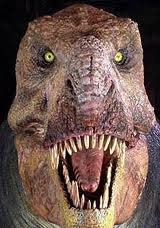
T-Rex
The sixth member of the Tyrannosaurus relations which is about 11 meters long called as small cousin of T-Rex was discovered in London.

A fresh dinosaur species that resembles the well-known marauder has been discovered in China by an Irish biologist.

Dr David Hone, a lecturer at UCD's School of Biology and Environmental Science, chief of an international team of scientists including one of the world's foremost paleontologists who newly recognized the new dinosaur.

Their conclusions will be in print in the scientific journal Cretaceous Research.
The new dinosaur Zhuchengtyrannus magnus remains were found after the area in Shangong province in eastern China.

After the foundation of the fractional skull and jawbones scientists consider that the creature would measured 11 meters long, stood four meters high and weighed almost six tonnes similar in size to the infamous T-Rex.
It is also believed to be one of the largest rapacious carnivores ever known by the scientists.

Along with this new one another species Asian Tarbosaurus by name joins an elite club of gigantic dinosaurs called tyrannosaurines that are whispered to have roamed North America and eastern Asia during the late Cretaceous Period between 65 and 99 million years ago.

They were gigantic beasts characterized by huge bone-crushing jaws, small arms and two-fingered hands.

Dr Hone said that it is hard explain he overall size of this animal with some skull and jawbones.

He also added that the frame is few centimeters smaller than the equivalent ones in the largest T-Rex specimen. So there is no distrust that Zhuchengtyrannus was a huge tyrannosaurine.

He said that the new dinosaur can be renowned from a new tyrannosaurines by a combination of exceptional features in the skull.

The new genus was named as Zhuchengtyrannus magnus which gives the meaning as Tyrant from Zhucheng