Thursday, November 4, 2010

ALVAREZSAUROIDEA

ALVAREZSAUROIDEA

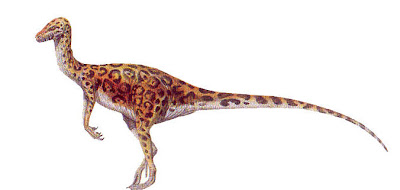
Alvarezsauroidea is a recently discovered, highly specialized group of maniraptoran theropods. Haplocheirus is the oldest known form, from the early part of the Late Jurassic of China; otherwise, the remaining alvarezsauroids (collectively the Alvarezsauridae) are from the Late Cretaceous. Alvarezsaurids are known from South and North America, Europe, and Asia. They have numerous bird-like features, and were once thought to have been specialized flightless birds. Alvarezsaurids range in the chicken-to-rhea sizes.

Alvarezsaurids have small beaky skulls with tiny teeth and hands in which the thumb is much more powerful than the other fingers.

In the Cretaceous Alvarezsauridae, the foprelimbs are further transformed into bizarrely poweful arms with a huge thumb claw and exceedingly small digits II and III. The alvarezsaurids have a backwards pointing pubis. Unlike the therizinosauroid and ornithischian situation, this backwards position of the pubis is more likely associated with changes in the locomotory muscles towards knee-driven power from the ancestral tail-and-femur driven power. Only a little is known of Alvarezsaurus itself (the basalmost form); somewhat more is known for the more derived Patagonykus and Achillesaurus (all from South America).

The highly derived Parvicursorinae (also called "Mononykinae"), in contrast, are known from many excellent specimens. The best studied are the Asian taxa Mononykus, Parvicursor, Xixianykus, and Shuvuuia. (However, North American forms such as Albertonykus are known). Parvicursorines have an extreme version of the arctometatarsus, in which the upper portion of metatarsal III is entirely missing. The parvicursorines show numerous cursorial adaptations, but these were almost certainly defensive. They seem to have been insectivores, and their forelimbs may have been used to batter into ant and termite nests. They have been found from deserts to well-watered environments.

The remaining maniraptorans are the oviraptorosaurs and the eumaniraptorans. These two groups are united by several important characteristics:

  • Another increase of brain size

  • Laterally directed shoulder joint

  • Honest-to-goodness true feathers on at least the arms and tail

  • Brooding on nests of eggs (may have been present in more basal coelurosaurs)

Wednesday, November 3, 2010

DEINOCHEIRUS

DEINOCHEIRUS
Kingdom: Animalia
Phylum: Chordata
Class: Reptilia
Superorder: Dinosauria
Order: Saurischia

Suborder: Theropoda
Infraorder: Ornithomimosauria
Family: Deinocheiridae
Genus: Deinocheirus

It is a large theropod dinosaur, known as ornithomimosaurian, which lived in southern Mongolia, during the late Cretaceous Period (around 70 million years ago)

Characteristics

The structure of its arms is similar to other dinosaurs of this group. This is the largest ornithomimosaur. The most well-preserved parts of Deinocheirus are its forelimbs, which measured long, with long claws.It had a Long arm with three long fingers on each hand

Facts Two long forelimbs and bits of ribs and vertebrae--that were dug up in southern Mongolia in 1970.

DEINOCHEIRUS forelimbs
  • Diet: carnivore (meat eater)

  • Meaning:”terrible hand”

  • Height: 12-20 feet (3.5-6mm)

  • Weight: 9,000kilos

  • Period: 70 million years ago

Friday, October 29, 2010

Hypsilodontid dinosaurs

Ornithopods

This is the group of dinosaurs that lived in southern Australia in the Cretaceous Period. While Hypsilodontids have been found worldwide, scientists have discovered a richness of species in southern Victoria. Being close to the South Pole, the climate there was quite cold, with long dark winters when there was no sunlight. Hypsilodontids may have exploited the near polar conditions better than other species. Fossils of about twelve species of Hypsilodonts have been found along the south coast of Victoria, including sites near Cape Otway.

The Hypsilodontid dinosaurs were Ornithopods, and were quite small, only up to 1 metre in size (about the size of a present day wallaby). They walked and ran on their hind legs, with a long neck, and a long balancing tail. They were herbivores, eating low growing vegetation such as the ferns and mosses that grew in the cold climate. Hypsilodontids had very large eyes and ability to see in poor light. This would have allowed them to find food during the long, cold winters.

Thursday, October 28, 2010

Coelurus - The Breast Footed Dinosaur

Coelurus

Coelurus or Coelurosauria, means vacant tail. It is a weekly identified species. It has a number of different things present in it. It is referred to s the small therpods. It is predictable as a simulated, polyphyletic coalition group. It is an extinct creature where it lived About 156 to 145 million years ago.

  • It is 6 feet long, it has been weighed as 20 kg and its thigh is 55 cm long.
  • It is light weighted where it can move beam and rapid.
  • The fossils were found in Wyoming , USA.

Coelurus had a petite head and it is taller than Ornitholestes. It had very long neck, a slim vertebra, particularly cervical and caudal parts of the bone formation. They had brawny pneumatic long bones with unfilled vertebrae and empty tail with amusingly great inner cavity along with thin walls.

  • They used to live in the woods.
  • It is the carnivores animal –used to feed on flesh.
  • It is heavy less and it can run much faster.
  • The predators cannot be easily touched.

Wednesday, October 27, 2010

THE TYRANT LIZARDS: THE TYRANNOSAURIDAE

TYRANNOSAURIDAE

The name says it all. This group of huge carnivores must have tyrannically ruled the land during the last part of the Cretaceous, 85 to 65 million years ago. Short but deep jaws with banana-sized sharp teeth, long hind limbs, small beady eyes, and tiny forelimbs (arms) typify a tyrannosaur. The Tyrannosauridae included such similar animals (in rough order of increasing size) as Albertosaurus, Gorgosaurus, Daspletosaurus, Tarbosaurus, and of course Tyrannosaurus rex. A tremendous skeleton of Tyrannosaurus now stands guard in the Valley Life Sciences Building, which houses the UCMP and the Department of Integrative Biology at UC Berkeley. Tyrannosaurs belong to the Saurischia, or "reptile-hipped" dinosaurs. Within the Saurischia, tyrannosaurids belong to the group of carnivorous dinosaurs known as theropods.

Traditionally, the tyrannosaurs have been included within the Carnosaura. In this classification scheme, carnosaurs represent the largest carnivorous animals to ever walk the land. However, recent work has shown that tyrannosaurs are in fact a highly derived group of coelurosaurs, which is mostly composed of smaller animals (including the smallest of all non-avian dinosaurs, the crow-sized Compsognathus, and also the birds). Tarbosaurus had a good sense of smell and had binocular vision, two characteristics that would have made it an excellent hunter.

How Did Tyrannosaurs Move?

Since tyrannosaurs were so huge, you might ask how they could move well and hunt prey? Many scientists familiar with the principles of biomechanics (physics applied to living organisms) think that tyrannosaurs could move fairly fast, maybe 10-20 mph, but not as fast as the smaller theropod dinosaurs.

Smaller tyrannosaurs like Albertosaurus or young individuals may have moved faster than the bigger ones like T. rex. Yet we still lack any clear evidence that tyrannosaurs could even run; some think that their body size limited them to only a fast walk, like an elephant. Trackways that unambiguously were made by tyrannosaurs would clarify the matter, but so far these are not known, apart from one probable footprint.

TYRANNOSAURIDAE

Tyrannosaur Fossils

Tyrannosaurs are surprisingly common in many North American fossil beds, especially their large, serrated teeth, which they shed periodically like most archosaurs. The teeth of tyrannosaurids are very interesting — rather than being the flat knifelike blades as in most other carnivorous dinosaurs, they are, as Berkeley's Professor Kevin Padian describes them, "like lethal bananas;" more like giant spikes than razor-edged blades. With a mouthful of this murderous fruitlike dentition, tyrannosaurs had a whopping bite, which might have made up for their reduced forelimbs.

The bite marks of these teeth are quite recognizable on some dinosaur bones. Some tyrannosaur fossils show evidence of bite marks from other tyrannosaurids, suggesting that there might have been fierce fighting between tyrannosaurs, or even cannibalism.

Tuesday, October 26, 2010

SALTOPUS – Jumping Foot

SALTOPUS

It is a minute bipedal dinosaur, looks like a small cat, empty bones which is similar to a bird. It is mostly know for the hind limb fragments. It is a extinct dinosaur (Late Triassic/Early Jurassic (235 to 200 million years ago))

Characteristics

It is a light weight dinosaur that walked on two legs and a stretched head with umber of tiny and spiky teeth’s. It has fingers on its hands, but the 4 and 5 finger is to small.


  • Weight-5 pounds

  • Length-3 feet
Diet and Habitat

  • Insects and small animals, and carrion (dead bodies of animals)
  • Resides in Scotland
Interesting facts

  • It was one of the first dinosaurs to travel the world. In fact, some scientists wonder if it wasn't actually a pre-dinosaur era reptile.
  • It is one of the nominal carnivores’ dinosaurs ever. It was rapid and chased its prey. Scientists think it may have even been able to jump.