Thursday, November 25, 2010

Troodon

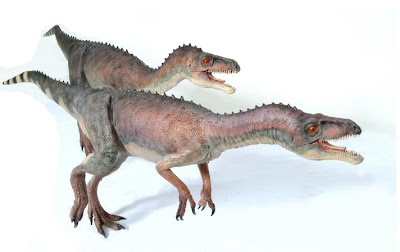
TroodonTroodon is a relatively small, bird-like dinosaur from the Late Cretaceous period. Found in 1855, it was the first dinosaurs found in North America. Its species ranged widely, with fossil remains recovered from as far north as Alaska and as far south as Wyoming and even possibly Texas and New Mexico.Troodon formosus (from Greek troo - to wound and odon - tooth) was a small possibly maniraptoran theropod dinosaur whose eating habits are still uncertain. This taxon is commonly recognized during excavation from its distinctive small teeth with large denticles along the trailing margin. While the dinosaurs may have ranged upwards to 6 feet (2 meters) in length, many of them must have been the size of chickens or smaller. The teeth size nearby microsites (localities in which most of the fossils are  small, being less than an inch, or 2 cm in length. These fossils are often teeth) are nearly microscopic, ranging upward to a few mm in length. Why the teeth are so small is difficult to understand, unless they are from very young dinosaurs that might have been feasting on the rotting carcasses of Edmontosaurus.
  • Found in: North America
  • Anatomy: Relatively large brain, large eyes and stereoscopic vision. Lightly built but agile, could run faster than most other dinosaurs of the time. It had excellent co-ordination and vision.
  • Length: 2 m
  • Height: 1-1.5 mTroodon
  • Weight (mass): About 40 kg
  • Locomotion: Bipedal
  • Food preference: Carnivore (small vertebrates, Lizards, mammals)
  • Time period: Cretaceous (76-74 million years ago)
  • Type of hip: Lizard hipped
  • Dinosaur group: Theropod
  • Remains: 1982 scientist in Alberta, Canada uncovered the fossilized brain case.

Wednesday, November 24, 2010

HETERODONTOSAURIDAE

HETERODONTOSAURIDAE
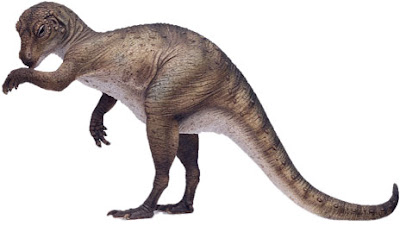
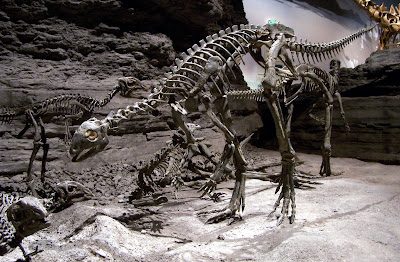
"Heterodontosaurus ("different-teeth lizard") Heterodontosaurids are known only from Lower Jurassic rocks of southern Africa. They were small dinosaurs with a length of 1 to 1.5 meters that had uniquely shaped cheek teeth, chisel-shaped with tiny cusps restricted to the apex of the crown (unique to all dinosaurs). They also had canine-like teeth in the front part of the mouth that had a different shape than the chisel teeth.
  1. Heterodontosaurus was 1.2 meters long, with short forelimbs and long hind limbs (considered to be bipedal).
  2. Dental battery set in massive lower jaws and the teeth are usually heavily worn (thus a plant eater).
  3. Long tail and short neck (typical of primitive ornithischian)
  4. Ossified tendons in the back region (along the vertebrae)
  5. Fusion of the fibula and tibia and their fusion to the tarsals, this stabilized the lower leg and ankle for fast running (bird-like feature - example of convergent evolution).
  6. Hands stout and flexible (perhaps to grasp vegetation)
  7. Large canines (tusk like)- may have been used for defense and display (this may be a sexual dimorphic feature, some heterodontosaurid skulls lack canines). The canines may also have helped to stabe and tear vegetation.

  8. Bones found in arid paleoenvironments (deserts and arid alluvial fans).
eggs
Description
The Heterodontosaurus was a bipedal/quadrupedal dinosaur. Its diet was low-growing plants. It had three kinds of teeth while most dinosaurs only have one type. The names of the three types are sharp upper front teeth, long canine tusks and high-crowned cheek teeth. It had three toes that faced forward on each foot. They had muscular arms and each hand had three large clawed fingers and two small fingers.
Residence
The Heterodontosaurus was 4 feet (1.2m) long and weighed 5.5 pounds (2.5kg). It lived in South Africa Cape, Province and Lesotho Quthing during the late Triassic and early Jurassic Periods
Male and Female
Adult male Heterodontosaurus have sharp canine like teeth that they most likely used to threaten and/or bite other competing males. Females and young males probably did not have those teeth. Their predators included theropods and crocodilians. While running it was probably on two legs and its tail wagged back and forth furiously unlike later ornithopods whose tail would straight. "

Tuesday, November 23, 2010

HADROSAURIDAE

HADROSAURIDAEThe Hadrosauridae are commonly known as the duck-billed dinosaurs. They first appeared in Medial Cretaceous time and were the last group of ornithopods to evolve. There is more known about this family than any other group of dinosaurs. Their fossil record includes many complete skeletons, eggs and nests, footprints, and two mummified individuals with skin intact (there are also other fossilized skin impressions of these dinosaurs).
The hadrosaruids were large ornithopods, with lengths of 7 to 10 meters. They had broad, toothless beaks and intricate dental batteries. The dental batteries consisted of hundreds of teeth with a washboard-like grinding surface and three replacement teeth in each tooth position. As in the hyspsilophodontids, they had kinetic jaws such that the upper jaw moved outward and the lower jaw moved inward during chewing. They could process fibrous vegetation, even twigs.
Two mummified hadrosaurids from Canada have stomachs full of conifer needles and twigs, seeds, and other tough plant material. There is very little variation among hadrosaurid skelet
Hadrosaurinae skull
ons, so identification is based on skull structure. There are two major subfamilies based on skull type, the Hadrosaurinae and the Lambeosaruinae
Hadrosaurinae
The hadrosaurines were the more primitive subfamily with rather flat skull roofs or solid crests on the skull. They were large "Roman-nosed" hadrosaurids with long nasals, which often peaked near the posterior end of the nostrils. Examples are Edmontosaurus and Maisauria.
Lambeosaurinae skull
Lambeosaurinae
These were the "crested" duck-bills. They are distinguished by convoluted tubes and crests on the tops of their skulls. The crests contained modified nasal passages and a nasal cavity that was relocated to a position above the orbits. The crests and tubes changed during the growth of individuals, suggesting that sexual dimorphism may have been present. The Upper Cretaceous genera Parasaurolophus and Corythosaurus are representative examples of lambeosaurines.
Short Description
  • Like iguanodontids, hadrosaurids were large, strong, quadrapedal walkers, but also could walk on two legs.

  • Mummies from Alberta have flaps of skin between fingers, has been suggested that they may have had webbed hands; however, the shrunk and stretched skin from mummification may only make it appear that way.

  • They had a tall, paddle-like tail, perhaps for propelling in water.

  • Their skeletons are found in river, lake, swamp, deltaic, and sea depositis. Perhaps they were aquatic dinosaurs. But hadrosaurids were also well suited to living on dry land and thus may have entered the water only for feeding or for defensive purposes.

  • Had a very wide geographic distribution, known from North America, Asia, Europe, and South America. But they were most abundant and diverse in Asia and North America.

  • The hadrosaurids were the dominant plant eating dinosaurs of the Late Cretaceous and they were among the last dinosaurs to become extinct.

Monday, November 22, 2010

HYPSILOPHODONTIDAE

HYPSILOPHODONTIDAE
The hysilophodontidae are the most primitive members of Euornithopoda and are a sister group within this clade to Iguandontia (which encompasses all more derivied euornithopods, including the Iguanodontidae and the Hadrosauridae [duck bills]).
Facts
  • The hypsilophodontidae were small (2 to 4 meters), bipedal ornithischians that are known from Middle Jurassic to Upper Jurassic rocks of North America, Europe, Asia, and Australia The best known genus is Hypsilophodon

  • Bipedal runner, hind limbs much longer than forelimbs.

  • Ankle elongate.

  • Long tail - stiffened by ossified tendons.

  • Skull resembles that of Heterodontasaurus, but does not have the large canine teeth.

  • Large eyes.

  • Massive jaws, dental battery of interlocking cheek teeth that wore-down to produce a continuous, inclined cutting edge.

  • A joint in the skull allowed the upper jaw to move outward over the lower jaw when chewing (a dynamic skull feature).
Hypsilophodonts are well known from complete skeletons and eggs. They were first known from the Middle Jurassic of China, but reached their peak diversity during Late Jurassic to Early Cretaceous. However, they did range to Late Cretaceous.

Two euornithopods that are very similar to the hypsilophodontids, and that may be very close to the evolutionary ancestral stock that links the hypsilophodontids to the iguanodontids, are Tenontosaurus (Lower Cretaceous of North America) and Dryosaurus (Upper Jurassic of North America and Africa).
Both lack premaxillary teeth and had other characters midway between the two groups (Lucas, 1997). However, some prefer to place these two dinosaurs as primitive members of Iguanodontia (which includes all more derived euornithopods above the hpsilophodontidae).

Friday, November 19, 2010

Iguanodon

Iguanodon

Iguanodon is best known from Lower Cretaceous rocks of Bernissart, Belgium (where 31 adult skeletons were found in a coal mine at a depth of 321 meters). It is much larger and more specialized than Camptosaurus

Iguanodon had the following characteristics

  • Had very long forelimbs (70 to 80% as long as hind limbs).
  • The wrist bones were fused (for stable hand walking).
  • Central 3 digits of the hand ended in hooves.
  • Large conical thumb spike (perhaps a defensive weapon).
  • Extensive boxwork of ossified tendons extending along the back vertebrae from the shoulder region to the middle of the tail.

Iguanodon probably did more quadrapedal walking than Camptosaurus or other small ornithopods. But could probably rear up on hind legs and swing its spike-like thumb for defense.


Description of Iguanodontids

  • Iguanodontid snouts were long with many more teeth than in heterodontosaurids or hypsilophodontids.
  • The beaks were used to crop vegetation.
  • Teeth leaf-shaped with long ridges on their sides and small cusps on the cutting edges (resembling teeth of the living iguanas - thus the name for the family).
  • Camptosaurus is the oldest iguanodontid and is best known from Upper Jurassic rocks of North America and Europe.Iguanodon skeleton
  • The zenith of iguanodontid diversity occurred in Early to Medial Cretaceous time in Europe, North America, Africa, Asia, and Australia.
  • Iguanodon, Lower Cretaceous of Europe, is the most typical representative of the Iguanodontidae and is the best known genus (with several complete skeletons known).
  • A particularly unusual Lower Cretaceous iguanodontid is Ouranosaurus from Niger, Africa, which had a very distinctive head and long neural spines along the back (see page 212 in Fastovsky and Weishampel, 1996).
  • There was a marked decline of iguanodontids in Late Cretaceous due (probably) to the appearance of the hadrosaurids (duck-bills).

Thursday, November 18, 2010

Eoraptor dinosaur

Eoraptor dinosaur

The Eoraptor lunensis, a medium-sized carnivore found in the Ischigualasto Formation of northwestern Argentina. The find occurs alongside other early dinosaurs and their kin, such as Herrerasaurus and Pisanosaurus.

Eoraptor lacks the specialized features of any of the major groups of dinosaurs, and is quite similar to what would be expected for dinosaur ancestors. This has led some to conclude that it is not part of the dinosaurs proper, but is a closely related archosaur. Others have pointed to the functionally three-fingered hand as an indication of close ties to theropod dinosaurs.

In any case, the traits of Eoraptor suggest that the first dinosaurs were small, bipedal predators. Taken together, the finds at Ischigualasto demonstrate that dinosaurs had radiated by the Late Triassic.

Eoraptor lunensis is roughly the same age as Herrerasaurus - 232 million years old - yet it already shows specialized features which indicate that it lies several branches up from the base of the dinosaurian family tree.

The exact nature of these features suggest that Eoraptor lies at the base of the great Theropoda lineage - the theropod dinosaurs - which includes many celebrity species, such as Tyrannosaurus rex, Allosaurus, Deinonychus, and Velociraptor. .

The upper Triassic Eoraptor is one of the earliest dinosaurs, close to the common dinosaur ancestor. Sereno considers it a primitive theropod, although others consider it a primitive dinosaur or pre-dinosaur.

Attractive features

Foundation- Patagonia, Argentina, South America

Analysis- It had light, hollow bones, a long head with dozens of small, sharp teeth, and five fingers on its hands (two of the fingers on each hand were very small)

Length-1 meterEoraptor skull

Height and weight – mass

Locomotion-Bipedal

Food-carnivore

Time period-228 million years

Dinosaur group-Theropod