Friday, January 28, 2011

Record-Breaking Eighth New Species of 2010

Newest dinosaur of latest Utah’s not gone extinct.

The upper jaw bone of the meat-eating creature, small enough to fit in the palm of the hand, was discovered in 2004 in a formation in the Crystal Geyser area near the Green River in eastern Utah, whereit lived 125 million years ago.


Iguanacolossus, found near Green River

Scientists speculate that it might have evolved into a highly intelligent creature.

Scott Foss regional paleontologist with the Bureau of Land Management said that “Its skull is six times larger than other dinosaurs”.Scott Foss said that “One [find] is unusual, eight is outstanding”. He also said that it is the newest creature featured in a paper published Wednesday in the online journal PLoS ONE.

“This string of dinosaur descriptions means that a full 1 percent of all known dinosaur species were described from lands in Utah during 2010,” said Foss.Foss said worldwide there are about 700 named dinosaurs.

Seven of the new species were found on BLM land and one in Dinosaur National Monument.Kirkland said he is unaware of such a characteristic in other fossilized dinosaurs and can only speculate on its purpose , he also added that ,”There’s no clue what it was used for”.

Thursday, January 27, 2011

Duck Billed Dinosaur

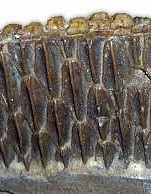
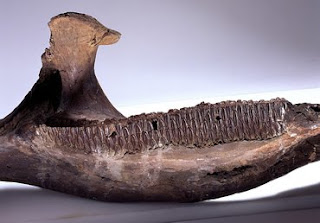
Unique ChewFossil lower jaw of Edmontosaurus showing its multiple rows of teeth

Hadrosaurs,the duck billed dinosaur could chew in a very unusual way.The scientists has this in the Proceedings of the National Academy of Sciences (PNAS) today.

Highly magnified scanning electron microscope view of surface of one of the hadrosaur teeth. The scratches are inside the boxes, which are less than 0.5mm in width. © Vince Williams, University of Leicester

Scientists, led by palaeontologist Mark Purnell of the University of Leicester, and including those from the Natural History Museum, discovered hadrosaurs had a unique way of eating, unlike any other creature alive.

Examining scratches

They examined tiny scratches on 67-million-year-old fossil teeth of an Edmontosaurus, a specimen from the Natural History Museum.

A different chew

The results showed the teeth movements were complex and involved up and down, sideways and front to back motion. Natural History Museum dinosaur fossil expert Paul Barrett explains.

Teeth from the lower jaw of a hadrosaur showing its multiple rows of leaf-shaped teeth. The worn, chewing surface of the teeth is towards the top. © Vince Williams, University of Leicester.

‘The results show that hadrosaurs did chew, but in a completely different way to anything alive today. As they bit down on their food the upper jaws were forced outwards, flexing along this hinge so that the tooth surfaces slid sideways across each other, grinding and shredding food in the process.’‘The lower jaws could also be moved back and forth, giving a second grinding action.’Teeth from the lower jaw of a hadrosaur showing its multiple rows of leaf-shaped teeth.

What they ate

The research also sheds light on what the dinosaurs ate. Vince Williams of the University of Leicester says, ‘Although the first grasses had evolved by the Late Cretaceous they were not common and it is most unlikely that grasses formed a major component of hadrosaur diets.’

Monday, January 24, 2011

PARROT SIZE DINOSAUR

Single Fingered Species

A new dinosaur species whose members were similar in size to a parrot having only one finger was discovered by a scientist. Scientists view that rare solitary digit as evidence that the evolution of dinosaurs was more complex than they first believed.


Parrot Size Dinosaur


The new dinosaur was found in rocks formed from 84 million to 75 million years ago in Linhe, a city near the Yellow River.The new dinosaur, called Linhenykus, "most likely grew to a few feet tall and weighed only as much as a large parrot", said Xu, who led the international team of scientists that discovered the species.

Xu and others believe theropod dinosaurs started with five fingers but evolved in later forms to have only three fingers. Some eventually became birds.Scientists have come to agree that the evolution of dinosaurs' hands was brought about more by random mutations than by basic adaptive evolution.

"The discovery of the one-fingered dinosaur only reconfirms the fact that digital reduction is a striking evolutionary phenomenon, far more complicated than we've expected," Xu said.The presence of only one finger in Linhenykus shows the vestigial fingers.Vestigial structures, like legs in whales and snakes, may appear and disappear seemingly randomly in the course of evolution," Choiniere said.

Sunday, January 23, 2011

Is 2011 Will See the End of Naked Dinosaurs?

The Years of the Naked Dinosaur

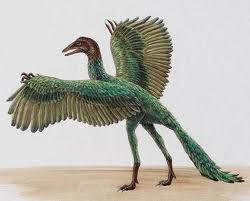
The animated short of Gertie the dinosaur was first shown in 1914. Dinosaurs are still largely depicted as being scaly creatures, often brightly coloured but, for the most part, completely naked. Will 2011 be the year when illustrators grasp the nettle and start to depict members of the dinosaur clade as feathered animals rather than scaly beasts?

Gertie The Dinosaur


How Dinosaurs are Illustrated

Gertie the dinosaur, one of the very first images of a moving dinosaur seen by members of the public was based on a Sauropod, a long-necked dinosaur.Scientists have a better understanding of the anatomy and physical structure of these animals. Trace fossils such as footprints have even hinted at dinosaur behaviour, but as to what colour they were - scientists remain very much in the dark. The colouration of dinosaurs is based on scientific assumption, as colour of rarely fossilises.

The amazing fossil finds over the last twenty years or so, most notably from Liaoning Province in northern China; have revealed that a number of small, meat-eating dinosaurs were feathered.The feathers, were simple in structure, more-like proto-feathers and quills, than the sophisticated feathers associated with a bird's wing.

Feathered Dinosaurs from China

A number of different types of feathered dinosaur are known from the early Cretaceous deposits of Liaoning. The fossils of these different types of dinosaur all show feather-like structures. If feathered dinosaurs existed here, then surely, they existed elsewhere.

So far the evidence for feathered dinosaurs is mostly associated with lizard-hipped dinosaurs, the Saurischians, but there is some other great group the bird-hipped dinosaurs, or Ornithischians may at least have had some feathered representatives. As the fossil evidence builds up, perhaps 2011 will mark a change in how the Dinosauria are depicted. Will feathered, or bristly dinosaurs become the norm, as opposed to seeing the naked scaly forms, so readily illustrated in scientific volumes and children's encyclopaedias of the 1960s, 1970s and 1980s?

Tuesday, January 18, 2011

Arctic and Antarctic dinosaurs

Arctic and Antarctic dinosaurs

Dinosaurs have recently been found in South Australia and North Alaska. At the time these places were nearer to the poles than today. Assuming that the obliquity of the Earth did not change, these dinosaurs must have lived throughout six-month-long nights. The local average annual temperature at the time has been very roughly evaluated from 0°C to 13°C (using hints from the plants and the oxygen isotopes), which is higher than today, but during winter the minimal temperature could have been around -11°C.

However, some primitive reptiles (champsosaurs) have been found at quite high latitudes from the middle Cretaceous of Canada.

The Australian polar dinosaurs were smaller than their tropical relatives, which indicates that there were important ecological constraints, one more hint in favour of a low temperature. Some of them have been shown to have had unusually big optic lobes in their brains, probably an adaptation to the polar nights.

It has been supposed that these dinosaurs did migrate to reach warmer places. In the case of Australia, however, an arm of the sea prevented them from going directly North, and they would had to run thousands of kilometres, which is the less probable as they were (for dinosaurs) relatively small. Moreover, some young remains have been found (in Alaska), making migration even less probable. They could also have hibernated, but they were probably too big to bury themselves, and (?) had no protecting fur. In any case, the developed sense of sight would have been useless if they had been away or sleeping during the polar night.

Thus these dinosaurs probably remained active in the cold. Mass homoiothermy could be the solution, but (besides general considerations against it, see below) the polar dinosaurs would then have had a tendency to grow, not to become smaller than their ancestors

Wednesday, January 12, 2011

An ancient hill where you can see thousands of dinosaur footprints

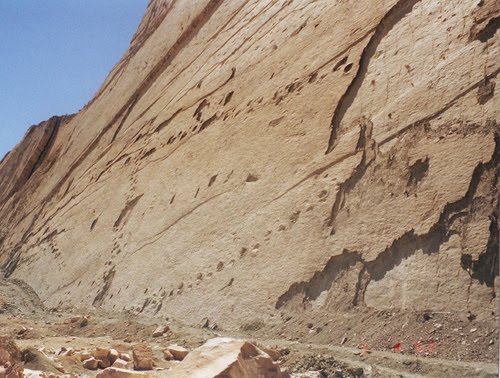
In Sucre, Bolivia, a limestone wall goes up at an angle above the ground, its surface criss-crossed with thousands of dinosaur tracks. It's the largest collection of dinosaur footprints in the world.

How did these 68 million-year-old prints wind up at this point?

The really strange thing is that the wall wasn't revealed until the mid-1990s, when workers from a close by cement factory saw it. According to Atlas Obscura:

It's indistinct how the wall went undiscovered for so long, as it is filled with more than 5,000 tracks made throughout the second half of the Cretaceous period about 68 million years ago.

There are so numerous tracks, really - and they're placed in such strange patterns - that scientists pass on to the area as a dinosaur dance floor.

So far, six distinct types of dinosaur prints have been recognized. One special track that measures 347 meters is the longest dinosaur trackway ever revealed and was made by a baby Tyrannosaurus Rex nicknamed "Johnny Walker" by some of the local researchers.

Eight other limestone walls with dinosaurs tracks have been establish in the region. Millions of years ago, when dinosaurs walked the earth, this area was part of a enormous shallow lake. The tectonic plate shifts throughout the Tertiary period that formed the great Andes Mountains also pushed some of these limestone walls out from the bed of the lake. The rock cliff measures about 325 feet high and juts into the sky at a 70 degree angle.