Friday, February 25, 2011

Flying Dinosaur

Ornithocheirus means the term bird hand and wasn't the largest pterosaur ever to take to the skies. Ornithicheirus
This creature was known to have lived in South America and Western Europe during the Middle Cretaceous period (i.e.) around 95 million years ago. Researchers say that it would have got a wing span of about 10 feet and it would have weighed around 70 pounds. Diet of these creatures would have been fish. These creatures had a thin snout and large wingspan with bony protuberance on the end.

Ornithocheirus --that honor belonged to the truly enormous Quetzalcoatlus--but it was the biggest avian reptile of the middle Cretaceous period, since Quetzalcoatlus didn't appear on the scene until tens of millions of years later. Aside from its 10- to 20-foot wingspan, what set Ornithocheirus apart from other pterosaurs was the bony "keel" on the end of its snout, which may have been used to crack the shells of crustaceans, to intimidate other pterosaurs, or to attract the opposite sex?


Ornithicheirus


Discovered in the early 19th century, Ornithocheirus occasioned its share disputes among the famous paleontologists of the day. This pterosaur was named by Harry Seeley, who chose its moniker (Greek for "bird hand") because he assumed Ornithocheirus was ancestral to modern birds.

He was wrong--birds actually descended from small theropod dinosaurs--but not as wrong as his rival Richard Owen, who at that time didn't accept the theory of evolution and thus didn't think Ornithocheirus was ancestral to anything!

Thursday, February 24, 2011

Giganotosaurus

The Giganotosaurus skeleton of dinosaurs resembles that it could come alive at any moment.

The massive reconstruction of the South American dinosaur is a focal point of the international exhibition, “Bigger than T. Rex: Giant Killer Dinosaurs of Argentina,” on display now at the museum.Giganotosaurus skeleton

The exhibit which opened in late January and runs through May 15 has garnered rave reviews from thousands of visitors.

There is great turnout for this particular exhibit, and everyone is really enjoying it,” says Bruce Winslow, director of the Alden B. Dow Museum of Science and the Arts.

We were hoping to average about 3,000 visitors a week, and we had more than 1,200 guests on a recent weekend.Seeing dinosaurs that were “bigger than T. Rex” is amazing, particularly for youthful viewers – and their parents, too.

The so-called “Twin Towers of Terror” includes the 45-foot Giganotosaurus skeleton and its companion, a 24-foot juvenile Mapusaurus skeleton.

The Giganotosaurus, which means giant southern lizard in ancient Greek, was one of the largest known terrestrial carnivores.

Giganotosaurus

Scientists estimate that the huge creatures weighed upwards of 10 tons with a skull length of more than six feet.

As might be expected, assembling the skeleton of the Giganotosaurus presented some unique challenges for the museum staff.

“Before we schedule an exhibit like this, we obviously first have to determine if the specimen will even fit in the space,” Winslow says, adding that 45-foot length of the giant southern lizard ended up being less of a spatial issue than its height.

The head had to be hoisted onto the skeleton using a forklift – that meant we had to have space above the head to maneuver it into position. The crew here made it work.

The multiple components of the big dinosaur arrived via semi truck. Reassembly of the Giganotosaurus involved a team of skilled professionals on the museum staff.

“Everything has to be aligned perfectly,” the director says. “The tail alone came in three sections; each piece had to be hoisted very, very gingerly and set into place.

Monday, February 21, 2011

Dinosaur That Lived During Jurassic Period

Seismosaurus was a sauropod and one of the largest animal ever to walk the earth, whose intelligence was very low in comparison with other dinosaurs.

It is said to be lived during the Late Jurassic Period, 156 million years ago.

Seismosaurus

It measured half a football field in length, is the longest dinosaur to date.

It is believed that this dinosaur may have lived in herds, but until more evidence is found, such as fossilized foot prints or several skeletons in the same place, this is just a speculation.

So far, paleontologist have only found one Seismosaurus skeleton, but a lot has been learned from it.

This skeleton was more or less complete.

When scientists uncovered the remains of the creature's stomach area they gathered a pile of about 250 gastroliths.

Most of these stones were about 2 inches in diameter and aided this large herbivore by crushing plant material into a pulp.


Seismosaurus


Seismosaurus had nostrils on top of its head.

It had a small head, and peg-like teeth sitting in front of its jaws.

Its forelimbs were shorter than its hindlimbs.

Its feet had five toes, and one of these was a thumb clawed.

It had a long wip-like tail which may have been used to lash out at a predator with.

Seismosaurus was a long neck dinosaur, bigger even than its close relative, Diplodocus.

Brachiosaurus

The Brachiosaurus that had a long neck, small head, and relatively short, thick tail is said to vary from other dinosaur that roamed the earth.

This difference came from the fact that Brachiosaurus was a giraffe-stanced sauropod, which means that the hind legs of the Brachiosaurus were shorter than the front legs.

This is also the reason why it is referred to as the 'arm lizard'.

Branchiosaurus

Brachiosaurus was named by Elmer S. Riggs, in 1903.

Brachiosaurus was a large plant eater.

This herbivore fed on conifers, ginkgos and cycads.

It was believed to have been between 80 and 85 feet long and weighed between 33 and 88 tons! Brachiosaurus was 23 feet tall, at the hips and stood between 40 and 50 feet tall at the head.

Like other Brachiosaurids, it had chisel-like teeth, its nostrils were on the top of its head, and it had large nasal openings indicating that it may have had a good sense of smell.

Brachiosaurus had 26 teeth on its top jaw and 26 on the bottom for a total of 52 teeth towards the front of the mouth.

The dinosaur lived during the late Jurassic period, about 156 million years ago.

The fossilized remains of the Brachiosaurus have been discovered in Colorado, USA, Tanzania and Portugal.

Brachiosaurus belonged to the phylum 'chordata', which means that the dinosaurs had a nerve chord that was hollow and ended in a brain. Brachiosaurus had socket set teeth and were lizard hipped.

Brachiosaurus was a warm-blooded animal, with large demands for energy by the body, on a daily basis, of probably more than 182 kg of food every day!

Tuesday, February 15, 2011

Is a dinosaur being lived in heard?

One of the most compelling evidence that dinosaurs traveled in large herds has just been uncovered in the Republic of Yemen. Researchers found tons of dinosaur tracks, unearthed by a local journalist, which show the footprints of both two-legged and four-legged dinosaurs roving in large groups in the Arabian Peninsula. This was before the Red Sea had formed, so the dinosaur probably just tromped there from Africa.


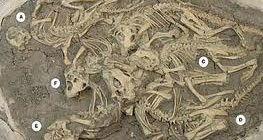
Fossilized heard of baby Psittacosaurus dinosaur


Some dinosaur species apparently lived in groups, as revealed by fossil evidence, which includes:

  • many fossils found together in bone beds (large deposits of bones of the same species in an area)
  • fossilized track ways of many dinosaurs travelling together
  • large groups of fossilized nests grouped together.

Some dinosaurs may have grouped together for protection like Hypsilophodon, and some may have cooperated for more effective hunting like Velociraptor. Some herds may have been temporary, however, with the dinosaurs simply congregating temporarily at rich feeding grounds.


Dinosaur Heard


Many plant-eating dinosaurs travelled in herds, feeding and perhaps nesting and migrating together. The advantage of congregating in herds was primarily in protection against predators (meat-eating animals).

Maiasaura fossils have been found in a huge group of about 10,000 animals. This strongly indicates herding behavior. These Maiasauras were buried in volcanic ash along with a field of nests and eggs.

Several hundred Coelophysis fossil skeletons have been found in Arizona, New Mexico, and perhaps Utah. Adults and juveniles of this meat-eating dinosaur have been found.
Other dinosaurs that may have travelled in groups were Ornithomimus and Dryosaurus.

Monday, February 14, 2011

Tyrannosaurus rex

Cliche says that Tyrannosaurus rex which weighed 5-7 tons is considered to be one of the deadly dinosaur. But the tyrant king was likely true to the billing. After all its bone-crushing jaws could splinter prey like toothpicks. Scientists wonder whether T. rex was more a lumbering scavenger or a quick and agile predator, but dead or alive, its meals were big, meaty and bloody. And T. rex wasn't the only deadly dinosaur, however. The globe was filled vicious killers.

Physical Description
Tyrannosaurus rex had two legs and was 40 feet long.

It’s jaws were up to 4 feet long and it's teeth grew up to be 13 inches long.

Tyrannosaurus rex had bumpy skin like a crocodile. Some scientists think T. Rex could go up to 15 MPH. The T-REX weighed 5-7 tons.

It’s arms were 3 feet long. T. Rex had a stride length of around 12 to 15 feet.


Tyrannosaurus rex

Classification:

Tetanurans.

Young Earth Age:
Alive sometime in the last 6000 years.

Old Earth Age:
According to old earth scientists, T-Rex lived in the Cretacious Period, about 85-65 million years ago.

Diet :
It was a carnivore (meat eating dinosaur).

Fossil locations:
T-Rex fossils have been found in North West America.