Monday, April 18, 2011

A Visit to Dinosaur Park

A Visit to Dinosaur Park

Even though Dinosaur died out there are abundance of tourism target to see Dinosaur fossils, eggs and much more. Here are the most excellent dinosaur tourism destinations in world.

Dinosaur Valley State Park, Glen Rose Texas - situated near the Glen Rose, Dinosaur Valley State Park is well-known for the well sealed tracks of dinosaur. The tracks are along the Paluxy River. Along with the tracks there are educational shows and two replicas of dinosaurs.

Dino Park

Dinosaur Provincial Park, Alberta - The Dinosaur Provincial Park in Alberta, Canada is an exclusive journey destination that attracts more than 350,000 tourists per year.

George S. Eccles Dinosaur Park, Utah - The George S. Eccles Dinosaur Park in Ogden has over 100 life mass copy of the dinosaurs. This is a great set to take you kids where they can slide down the snout of a dinosaur or mount inside the head of Triceratops. The park also provides in turn on dinosaur’s findings in Utah. The best movement in the park is to dig out real dinosaur bones in the sand along with paleontologists.

Dinosaur National Monument, Jensen - The best characteristic of the Dinosaur National Monument is the Douglass Quarry at the Dinosaur Quarry Visitor Center where tourists can observe well preserved 1500 dinosaur fossils uncovered in the cliff. Douglass Quarry yields one of the best photos of Jurassic Period dinosaurs in the world.

Balasinor Jurassic Park, Gujarat - The little city of Balasinor is often described as Jurassic Park of India. The place is famous for the 150 million years old dinosaur remnant and eggs. The is the only place on Earth where tourists can hold a 150 million year old dinosaur egg in their hand. Around 9 type of dinosaurs are extracted at Balasinor.

Tuesday, April 5, 2011

Outsized Species

Zhuchengtyrannus-Bmagnus

The Zhuchengtyrannus magnus, a newly revealed giant theropod from China, is considered to be the biggest plant-eating dinosaurs forever identified by paleontologists.

Its enormous dimensions draw closer in at four meters tall and 11 meters long and its weight is around 6 tonnes.

Magnus was an element of the tyrannosaurines collection immense, bipedal theropods like the Asian Tarbosaurus.

It is believed to be roamed around North America and eastern Asia all through the late Cretaceous Period which is about 99 to 65 million years ago.

Zhuchengtyrannus is recognized by its exclusive characteristics in its skull and teeth.


It was originated in the Chinese city of Zhucheng which lies in the eastern Shandong Province.

This tyrannosaurine, along with the T. rex, fit into a group of massive theropods known as “beast-footed” dinosaurs.

They were called so since they known for their bone-crushing jaws.


Friday, April 1, 2011

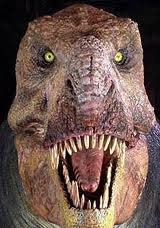
Detection of T-Rex’s kin

T-Rex
The sixth member of the Tyrannosaurus relations which is about 11 meters long called as small cousin of T-Rex was discovered in London.

A fresh dinosaur species that resembles the well-known marauder has been discovered in China by an Irish biologist.

Dr David Hone, a lecturer at UCD's School of Biology and Environmental Science, chief of an international team of scientists including one of the world's foremost paleontologists who newly recognized the new dinosaur.

Their conclusions will be in print in the scientific journal Cretaceous Research.
The new dinosaur Zhuchengtyrannus magnus remains were found after the area in Shangong province in eastern China.

After the foundation of the fractional skull and jawbones scientists consider that the creature would measured 11 meters long, stood four meters high and weighed almost six tonnes similar in size to the infamous T-Rex.
It is also believed to be one of the largest rapacious carnivores ever known by the scientists.

Along with this new one another species Asian Tarbosaurus by name joins an elite club of gigantic dinosaurs called tyrannosaurines that are whispered to have roamed North America and eastern Asia during the late Cretaceous Period between 65 and 99 million years ago.

They were gigantic beasts characterized by huge bone-crushing jaws, small arms and two-fingered hands.

Dr Hone said that it is hard explain he overall size of this animal with some skull and jawbones.

He also added that the frame is few centimeters smaller than the equivalent ones in the largest T-Rex specimen. So there is no distrust that Zhuchengtyrannus was a huge tyrannosaurine.

He said that the new dinosaur can be renowned from a new tyrannosaurines by a combination of exceptional features in the skull.

The new genus was named as Zhuchengtyrannus magnus which gives the meaning as Tyrant from Zhucheng


Sunday, March 27, 2011

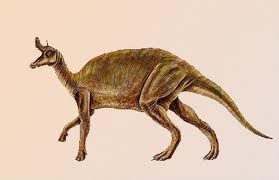
Dinosaur with distinctive cranial crown

Lambeosaurus a hadrosaurid dinosaur lived about 76 to 75 million years ago during the Late Cretaceous Period in the region of North America. This bipedal or quadrupedal, plant-eating dinosaur was recognized for its unique concave cranial crest It is about 15 meters long. The Mexican species L. laticaudus was considered to be one of the highest ornithischians.


Lambeosaurus
Lambeosaurus was tardily described by William Parks in 1923.Twenty years later the first matter was premeditated by Lawrence Lambe. The genus had a difficult taxonomic record since small-bodied cranial hadrosaurid were recognized as infantile and thought to belong to own genera and species. At present, a variety of skulls are allocated to the type species L. lambei and the interpretation shows the age differences and sexual dimorphism between the skulls.

Lambeosaurus directly relates to a species name Corythosaurus, which is found vaguely in older rocks. All had strange crests, which are served for some social functions like noisemaking and identification. Lambeosaurus was pretty parallel to the famous Corythosaurus in everything except in the form of the head decoration. In comparison with Corythosaurus, the crown of Lambeosaurus was moved ahead, and the concave nasal passages are at the front of the crest and stacked vertically.

Lambeosaurus move on two legs as well as with four which is exposed by footprints of related animals. It had an elongated tail stiffened by hardened tendons that is used to prevent it from sagging. The hands consist of four fingers lacking the innermost one of the comprehensive five-fingered tetrapod hand. The second, third, and fourth fingers were clustered together with weary hooves suggesting that the animal could use the hands for sustain. The fifth finger was liberated and used to work on some objects. Each foot of Lambeosaurus had only three central toes.


Visit: Child Development (8th Edition) by Laura E. Berk

Friday, March 25, 2011

Fossilized footpath of dinosaur

The collection of dinosaur footprints varies from few inches to around few feet across and the biggest footprints belonged to the huge long necked and tailed plant-eating dinosaur called sauropods.The theropods which are the meat-eating dinosaurs comprised of three-toed feet.The feet of plant-eating dinosaurs vary from meat-eating dinosaurs.

Dinosaur footprints usually made in sludge or fine sand have been found over 1500 places including quarries, coal mines, riverbeds, deserts, and mountains.There are many fossils found as each dinosaur made many tracks it can fossilize well.Moreover relating a set of tracks with a particular genus is normally impossible.


Real foot prints
The subsequent are the information about fossil footprints,
Speed
Length of stride,
The bone structure of the foot,
Irritating behavior the existence of herds,
Whether they walked on two or four legs and how their tail was carried.

Dinosaur footprints are extremely rich in many areas, and provide prosperous sources of scientific information on dinosaur behavior, locomotion, foot anatomy, ecology, chronology, and geographic distributions.The extensive revival of significance in dinosaurs has been liked by a new interest in dinosaur tracks.

Today countless professional "trackers" are vigorously studying about the footprints of dinosaur all around the world. For ruling, documenting, and interpreting dinosaur footpaths include tackle and techniques which varies from those applied to corpse fossils. A number of admirable dinosaur footpaths are now available to the public.

Theropod track
Some footpaths are so fresh- looking which is hard to imagine that the track-walkers having stridden by only moments before.Until the desire of cloning dinosaurs becomes a reality, this is probably the closest one we can come to stand beside a breathing dinosaur.

Monday, March 21, 2011

Running Lizard

The Dromaeosaurus which had remarkably large eyes and excellent vision resembles the Velociraptor, lived during the Late Cretaceous period.

The name means 'running lizard' and is derived from the Greek dromeus meaning 'runner' and sauros meaning 'lizard'.

Dromaeosaurus was a small carnivore, the size of a wolf, about 2 m in length and 15 kg in weight. Its mouth was full of sharp teeth, and it had a sharp "sickle claw" on each foot.

It lived during the Campanian stage of the Late Cretaceous, however, some fragmentary remains such as teeth which may belong to this genus have been found from the late Maastrichtian age Lance and Hell Creek Formations, dating to 65.5 million years ago.

Although only a few bones are known from the hind limb, they indicate that Dromaeosaurus was a powerfully built animal.

The presence of feathers in closely related animals makes it extremely likely that it was feathered as well.

It also probably had a good sense of smell and hearing. Its neck was curved and flexible and its jaws were solidly built.

Dromaeosaurus
The tail was flexible at the base but sheathed in a lattice of bony rods; this allowed it to be carried in a sharply upturned position.

In Dromaeosaurus albertensis, the vena capitis dorsalis "drains the anterior neck muscles through a pair of long canals on the posterior surface of the endocast."

Despite receiving widespread attention in popular books on dinosaurs, and the usage of a complete mounted skeleton cast in museums throughout the world, Dromaeosaurus is surprisingly poorly known from actual fossils.

The first known Dromaeosaurus remains were discovered by paleontologist Barnum Brown during a 1914 expedition to Red Deer River on behalf of the American Museum of Natural History.

The area where these bones were collected is now part of Dinosaur Provincial Park in Alberta; Canada.

The find consisted of a partial skull 24 cm in length, and some foot bones. Several other skull fragments, and about 30 isolated teeth, are known from subsequent discoveries in Alberta and Montana.

Several species of Dromaeosaurus have been described, but Dromaeosaurus albertensis is the most complete specimen.


Visit: Behavior Management: Applications for Teachers (5th Edition) by Zirpoli