Tuesday, April 24, 2012

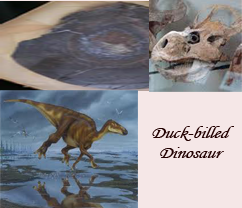
Duck-Billed Dinosaurs Endured extensive, dim Polar Winters

Duck-Billed Dinosaurs
Duck-billed dinosaurs that lived within Arctic latitudes about 70 million years ago probable endured extensive, dark polar winters instead of migrating to more southern latitudes, a new study by researchers from the University of Cape Town, Museum of natural world and Science in Dallas and Temple University has found.

The Museum of Nature and Science, a paleontologist Anthony Fiorillo excavated Cretaceous Period fossils along Alaska's North Slope. Most of the skeleton belonged to Edmontosaurus, a duck-billed herbivore, but some others such as the horned dinosaur Pachyrhinosaurus were also found.

Fiorillo hypothesized that the microscopic structures of the dinosaurs' skeleton could prove how they lived in Polar Regions. He enlisted the aid of Allison Tumarkin-Deratzian, an assistant professor of earth and environmental science, who had both skill and the services to make and check thin layers of the dinosaurs' bone microstructure.

"The bone microstructure of these dinosaurs is really a record of how these animals were rising throughout their lives," said Tumarkin-Deratzian. "It is about alike to looking at tree rings."

Thursday, April 12, 2012

Enigmatic Dinosaurs egg discovered in Patagonia

Enigmatic Dinosaurs
An Argentine-Swedish explore team has reported a 70-million-year-old pocket of fossilized bones and unique eggs of an enigmatic birdlike dinosaur in Patagonia.

"What makes the discovery unique are the two eggs sealed near articulated bones of its hind limb? This is the first time the eggs are originated in a seal proximity to skeletal remains of an alvarezsaurid dinosaur," says Dr. Martin Kundrat dinosaur specialist from the group of Professor per Erik Ahlberg at Uppsala University.

The dinosaur represents the newest survivor of its kind from Gondwana, the southern island in the Mesozoic Era.

The creature belongs to one of the strangest groups of dinosaurs, the Alvarezsauridae, and it is one of the major members, 2.6 m, of the family.

The two eggs establish mutually with the bones during the journey might have been inside the oviducts of the Bonapartenykus feminine when the creature perished.

"During examination of the shell samples using the electron scanning microscopy observed strange fossilized substance inside of the pneumatic canal of the eggshells. It twisted out to be the first proof of fungal contamination of dinosaur eggs.

Wednesday, April 4, 2012

Shaggy T. Rex Cousin Was Heftiest Feathered Dinosaur

Shaggy T. Rex Dinosaur

The recently unearthed tyrannosaur, named Yutyrannus huali or "stunning feathered tyrant," lived about 125 million years ago in northeastern China. The over 29-foot-long non-avian dinosaur, represented by three specimens, is significantly smaller than its notorious relative T. rex.

"The largest specimen conserve feathers on the tail, and two lesser specimens protect feathers over the neck, on the forelimbs, near the pelvis, and even feet," lead author Xing Xu, a lecturer at Beijing's Institute of Vertebrate Paleontology and Paleoanthropology, said.

Xu and his colleagues analyzed the remains of the three dinosaurs and exposed that patches of filamentous structures were near the frame on the slabs containing the specimens.

The researchers consider that when the dinosaurs were alive, these easy structures would have been additional like the hairy down of a contemporary infant chick than the stiff plumes of a mature bird.

"The dimension, structure and extent of the feathers suggests that they would have shaped a shaggy body covering that would have had at least some insulating purpose,"

Wednesday, March 28, 2012

Fossils of dicynodont exposed on each continent

Dinosaur Fossils
Fossils discovered on a Tasmanian beach have established the survival in Australia of the dicynodont – an odd-looking species that lived 30 million years previous to the dinosaur – proving it existed on all continents.

The fossils were established by a pair strolling on a seaside on the Tasman Peninsula. The plant-eating animals, about the size of a cow, lived about 250 million years ago and became destroyed about 20 million years ago.

Complete specimens of the dicynodont have been establishing in India and South Africa. The detection of the two skull pieces found in Tasmania has enabled scientists to verify that the creature lived in Australia. The only other proof was a fossil found in Queensland in 1983.

A paleontologist of Queensland Museum, Dr Andrew Rozefelds said the "strange-looking beast” may have survived longer in Australia than on other continents.

Australia is an island continent and perhaps some things like the monotremes, like the platypus and the echidna, survived here as elsewhere in the earth they became extinct.

Wednesday, March 21, 2012

Small Four-Winged Dinosaur Sported Shimmery Black Feathers

Four-Winged Dinosaur
A new fossil of a four-winged dinosaur concerning the dimensions of a pigeon shows he apparently sported quite the costume, complete with shiny black feathers and a tail tipped with a combine of ornamental streamer feathers.

The newly exposed fossil of Microraptor lived about 130 million years ago, through the early Cretaceous period, in what is nowadays northeastern China.

The researchers compared the agreement of these melanosomes with those of modern birds. When melanosomes are stacked tidily, the feather looks darker; when they are further muddled, the feather appears lighter.

From their analysis of modern birds, the researchers figured that this Microraptor fossil had black feathers. In addition, the narrow stacking of the melanosomes would have known the feathers iridescence.

The researchers couldn't be sure of the dye of the sheen, or the result of the iridescence on the quill color, because those factors depend on the width of the feather's keratin coat.

Wednesday, March 14, 2012

Collection of huge dinosaur bone found

Dinosaur Bone


The enormous scrape bone of a big meat-eating dinosaur has been exposed at Lightning Ridge, in the collection of the Australian Opal Centre.

One hundred million years ago at Lightning Ridge, a big dinosaur with hideous hand claws roamed the forests. This was a frightening huntsman that caught and slashed its quarry with claws like grappling hooks.

The bone is decomposed along one surface, but when absolute it would have been about 15 centimeters extended.

“We can recognize it by comparing it to extra scrape bones in the AOC set, and by referring to dinosaurs from elsewhere in Australia and overseas,” Elizabeth said.

The Carters Rush dinosaur was maybe four metres lengthy and up to three metres high at the trendy, same in size to Allosaurus from North America. This is the main theropod dinosaur ever exposed in NSW, and one of Australia’s biggest therapies.