Thursday, June 14, 2012

Dino Snores for Grown-ups at the Natural History Museum at 9th June 2012

Dinosaur Meseum
Come along to our new sleepover event for a stylish night of music and science, art and cinema, and dinner in London's celebrated dinosaurs home.
Event info: 
First sleepover: 17 August 2012
Event starts at 19.30, ends 9.30 the following day
Cash bars open in Fossil Way and the Central Hall Cafe
£175 per person, Members price £160

Event Highlights:
  • 3-course dinner and breakfast in the Museum's Restaurant
  • sleeping in the Central Hall under our iconic Diplodocus frame, Dippy
  • Nature Quiz at dinner with wonderful prizes to win, including Museum Memberships and Crime Scene Live tickets
  • science show featuring gruesome forensics and the sex lives of insects
  • A hilarious comic set with award-winning comedian Tom Allen
  • Unusual midnight feast with an edible-insect tasting.
  • Free admission to special exhibitions, Scott's Last Expedition and Animal Inside Out
  • life-drawing class in the Darwin Centre hall
  • live tune in the Central Hall Cafe
Note:
Places are limited so you'll require to book early to secure your place. This event is not appropriate for hen and stag parties.

Monday, June 4, 2012

Modern Birds are actually Baby Dinosaurs

Modern birds hold the physical individuality of baby dinosaurs, according to a new Nature study that found birds are even more closely linked to dinosaur than before thought.

Depending on the non-avian dinosaur and bird compared, that might be tough to consider. When researchers go beyond the surface to the tissue and skull levels, however, the similarities become extra obvious.

"The evaluation of the many characteristics of birds –- things like feathers, flight, and wishbones -– has usually been a hard problem for biologists," Mark Norell, chair of the division of paleontology at the American Museum of Natural History and one of the paper's co-authors, added.

"By analyzing fossil proof from skeletons, eggs, and soft tissue of bird-like dinosaurs and primitive birds, we've learned that birds are living theropod dinosaurs, a group of carnivorous birds that include Velociraptor," Norell sustained.

"This new work advances our knowledge by providing an authoritative example of how developmental changes played a main role in the source and development of birds."

Thursday, May 17, 2012

Science casts a fresh eye on dinosaur history

Dinosaur Meseum
Much of what we thought we knew about dinosaurs is altering as fresh science creates new pictures of these antique creatures and how they lived.

New discoveries of smaller dinosaurs from China have exposed many were enclosed in feathers. Paleontologists now consider many dinosaurs were warm-blooded and some even lived in areas that saw snow.

"What you used to think about dinosaurs, maybe you should imagine about them in a different way," says Richard Hebda, paleontologist with the Royal B.C. Museum, where the travelling show Dinosaurs, antique Fossils, New Discoveries opens Thursday.

 "It tries to offer a look at how these organisms lived and behaved and there is  a bit on what type of world they lived in."

The show, assembled by the famous American Museum of Natural History in New York City, runs until Sept. 16 in Victoria.

Scientists now consider dinosaurs were much more active than the ponderous, giant lizards once imagined. Instead of spending most of their time in water to support their giant size, they likely ran, jumped and even migrated over dry land.

Long-necked dinosaurs were before pictured living and feeding from treetops with their necks extensive straight upwards, like giraffes.

Monday, May 14, 2012

Robotic Dinosaurs on the technique for Next-Gen Paleontology

Dinosaur
Researchers at Drexel University are bringing the newest technical advancements in 3-D printing to the study of antique life. Using scale models of real fossils, for the first time, they will be able to check hypotheses about how dinosaurs and extra primitive animals moved and lived in their environments.

"Technology in paleontology hasn't tainted in about 150 years," said Drexel paleontologist Dr. Kenneth Lacovara, and relate professor in the College of Arts and Sciences. "We use shovels and pickaxes and burlap and plaster. It hasn't distorted until now."

Lacovara has begun creating 3-D scans of massive dinosaur bones and other fossils in his lab. The 3-D scan puts a virtual picture in a digital workplace that researchers can control and analyze.

To transport these scans to life, Lacovara is also teaming up with mechanical engineer Dr. James Tangorra, an assistant professor in Drexel's College of Engineering, to use 3-D printing technology to make and check scale models of fossil bones.

A 3-D printer is a technology for fast prototyping and developed objects based on a digital design. Common models work by regularly extruding very thin layers of a resin or added material, building up strata to make a physical object.

Tuesday, May 8, 2012

Twinky the baby dinosaur arrives in Singapore

It exhausted one month at sea, journeying from the jagged, liberal and frosty American state of Utah to the flat, little and tropical island of Singapore.

And last Wednesday nighttime, Twinky, the baby dinosaur, arrived in its adopted land - packed in 12 crates on a 20-foot container.

But it will be a while before Singapore will reveal the unusual 12m long discover at its new home, as the yet-to-be-built Lee Kong Chian Natural History Museum will be prepared only in two years' time.

The 7,500 sq m purpose-built museum at the National University of Singapore (NUS) will house not just Twinky and two bigger dinosaurs, but also one of the major collections of South-east Asian animals in the county.

For now, Twinky will stay patiently in an unnamed temperature-controlled and protected warehouse for its star turn - and the arrival of its 'parents'.

Twinky, Apollo and Prince were set up buried mutually in a quarry in Wyoming between 2007 and 2010.

Tuesday, April 24, 2012

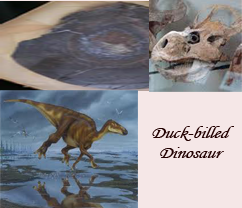
Duck-Billed Dinosaurs Endured extensive, dim Polar Winters

Duck-Billed Dinosaurs
Duck-billed dinosaurs that lived within Arctic latitudes about 70 million years ago probable endured extensive, dark polar winters instead of migrating to more southern latitudes, a new study by researchers from the University of Cape Town, Museum of natural world and Science in Dallas and Temple University has found.

The Museum of Nature and Science, a paleontologist Anthony Fiorillo excavated Cretaceous Period fossils along Alaska's North Slope. Most of the skeleton belonged to Edmontosaurus, a duck-billed herbivore, but some others such as the horned dinosaur Pachyrhinosaurus were also found.

Fiorillo hypothesized that the microscopic structures of the dinosaurs' skeleton could prove how they lived in Polar Regions. He enlisted the aid of Allison Tumarkin-Deratzian, an assistant professor of earth and environmental science, who had both skill and the services to make and check thin layers of the dinosaurs' bone microstructure.

"The bone microstructure of these dinosaurs is really a record of how these animals were rising throughout their lives," said Tumarkin-Deratzian. "It is about alike to looking at tree rings."